
February 5, 2026
Little Stories: Why is it difficult to accept contemporary art?
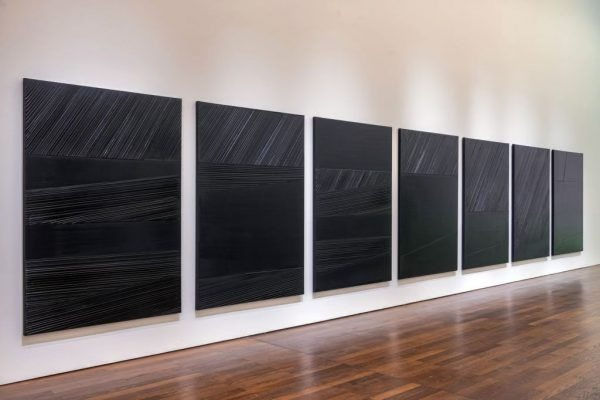
You look at Pierre Soulages’s black painting and try to grasp the thought behind it: “The point is not the colour black, but the light.” You pour yourself a second glass and follow the twists and turns of his thinking. How are we to understand contemporary art while living within a different discourse—as if “on the other side of the fence of understanding”?
How much time does the average visitor actually spend in a contemporary art gallery or museum? Perhaps a few dozen seconds in a gallery; somewhat longer in a museum, since there is also the cloakroom, the restroom, the bookshop, and the café. If we measured it by walking pace, we would probably arrive at something along those lines. The content on display loses out to the amount of time we are willing to give it.

“Contemporary art is in crisis!” We hear this phrase all the time. Yet contemporary art has been in crisis for at least the past five hundred years. Crisis, it seems, is its permanent condition.
The great Caravaggio was rejected for his radical naturalism: he painted saints with wrinkles and dirty feet. It was a radical move against the prevailing current, provoking resistance from the Church. Even El Greco failed to conform to the rhythms and ideals of the Renaissance—his otherness condemned him to nearly three centuries of obscurity.
And what about the Impressionists, who rejected the conventions of “perfect” academic art and searched for new ways of creating in the open air rather than in the studio? Were they not regarded as destroyers of art?
Saying “I don’t understand contemporary art” is a natural reaction—art does not always have to be understood, nor is understanding its only purpose.
And today we still hear: “I don’t understand contemporary art.” Whenever a new art form emerges, the journey towards the canon begins all over again. Society often rejects it, critics analyse and interpret it, institutions legitimise it, works enter the canon—and then a new radical stimulus appears. The cycle repeats itself.
It is often said that art stands at the forefront of society’s development. But perhaps society does not so much “grow” to understand art as it is gradually presented with a constructed system of value that eventually becomes the norm. Institutions create artistic value and immortality, while over time society sustains the symbolic capital of an artist’s work. This is how the system of artistic value formation operates.
Why does contemporary art unsettle an established social order? Because it disrupts—or, more gently, reshapes—established aesthetic standards and invites us to critically reconsider what we take for granted. At times, we must also come to terms with the creative impulses of younger artists: their revolutionary manifestos, their desire to stand apart, and their search for a new language, one that is often understood only by their own generation. Everyone else needs translators.

If I were to say that I see little depth in some of the work produced by the younger generation, that its meaning remains veiled in doubt, or that the title or description of a work is more complex than the work itself, that would most likely be my problem. Perhaps I am searching for something that disappeared with my generation—or even earlier. As has been said, every generation has its own horizon of expectations. One could also put it this way: new art often appears “bad” simply because it does not correspond to the viewer’s experience.
Sometimes, then, all that remains is to accept reality as it is. The horizon expands. The rejection of contemporary art is normal. Its development takes place through conflict, debate, and shifting interpretations. Saying “I don’t understand contemporary art” is a natural reaction—art does not always have to be understood, nor is understanding its only purpose.
We are witnessing an enormous proliferation of contemporary art. Most of it will disappear into oblivion—or, more likely, never even rise from the lowlands burdened with expectations. We see everything, and it is not easy to respond to every work by searching for some profound underlying meaning. Rejection—or even outright dismissal—can resonate more strongly, and sometimes, along with one particular work that provokes an almost allergic reaction, we end up throwing out contemporary art altogether.
But it is essential to respond, to question, and to doubt. I do not know whether the direct purpose of contemporary art is to stimulate our minds, but reflection is necessary. As always, time eventually puts everything in its proper place. This is how the boundaries of our social field and our understanding of the world expand, and contemporary art, despite all its contradictions, contributes to that process.
To the eyes of their own time, Soulages, Caravaggio, and El Greco were contemporary artists too.